Parents and educators often admire Montessori classrooms for their beautiful, purposeful materials that invite children to explore and learn at their own pace. Each set of materials is carefully designed to match a child’s stage of development, from simple object permanence boxes for toddlers to advanced math tools for elementary students. Rather than dividing learning strictly by grade, Montessori organizes materials by age ranges and developmental stages. Below, you’ll find a guide to common Montessori materials organized in a way that mirrors grade levels, making it easier to see how the hands-on learning experience grows with your child.
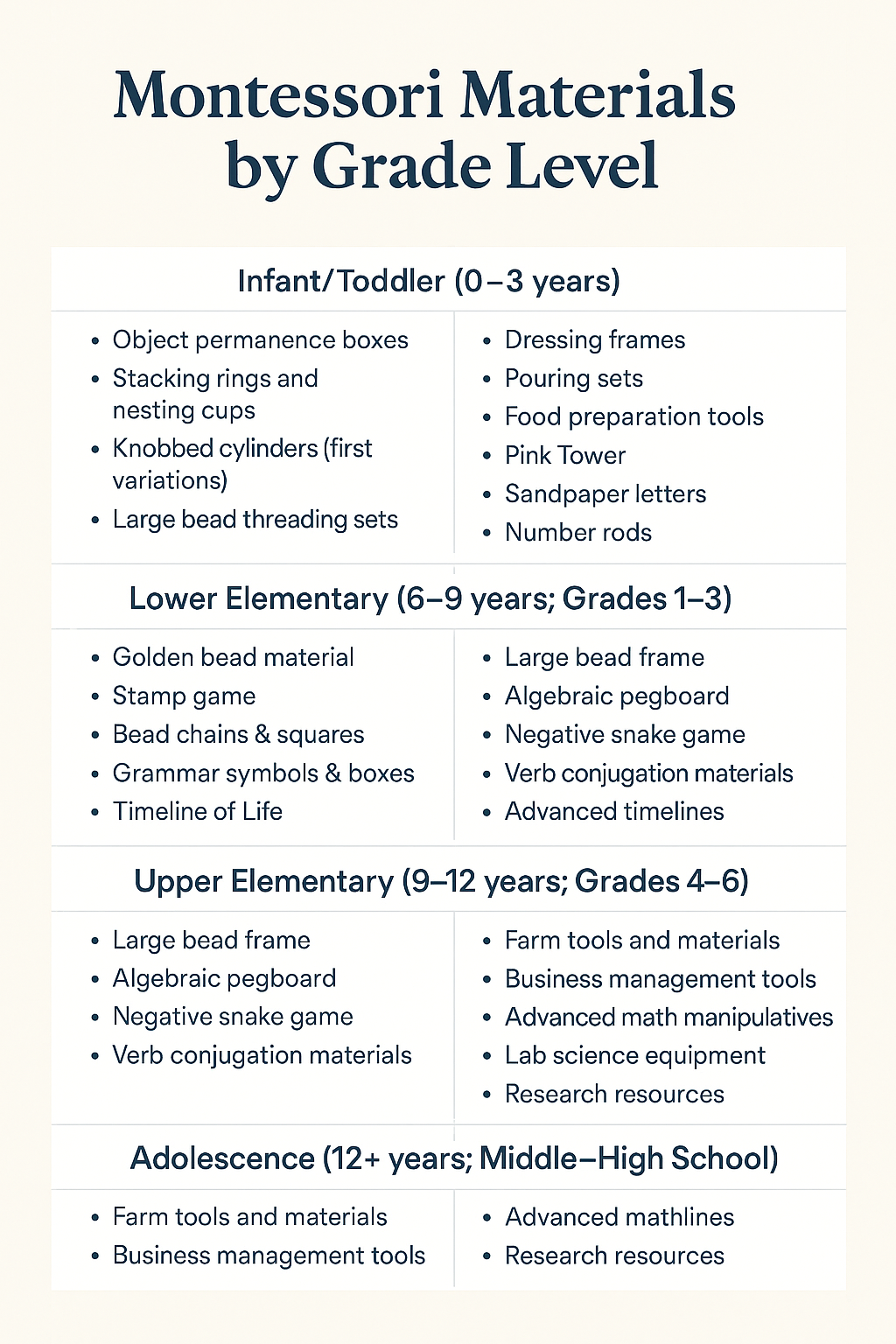
Infant/Toddler (0–3 years)
- Object permanence boxes
- Stacking rings and nesting cups
- Knobbed cylinders (first variations)
- Large bead threading sets
- Practical life tools (spoons, pitchers, dressing frames with large buttons/zippers)
- Simple puzzles with knobs
- Soft blocks, sorting trays
- Mirror for movement exploration
Primary / Children’s House (3–6 years; Preschool–Kindergarten)
Practical Life
- Dressing frames (buttons, snaps, laces, zippers, buckles, hooks & eyes, etc.)
- Pouring sets (water, beans, rice)
- Spooning, tonging, and tweezing activities
- Food preparation tools (peelers, cutting boards, child-safe knives)
- Cleaning tools (brooms, dustpans, mops, sponges)
Sensorial
- Pink Tower
- Brown Stair
- Knobbed and knobless cylinders
- Color tablets (box 1–3)
- Sound cylinders
- Smelling jars
- Touch boards & fabrics
- Geometric solids
- Constructive triangles
- Binomial cube & trinomial cube
Language
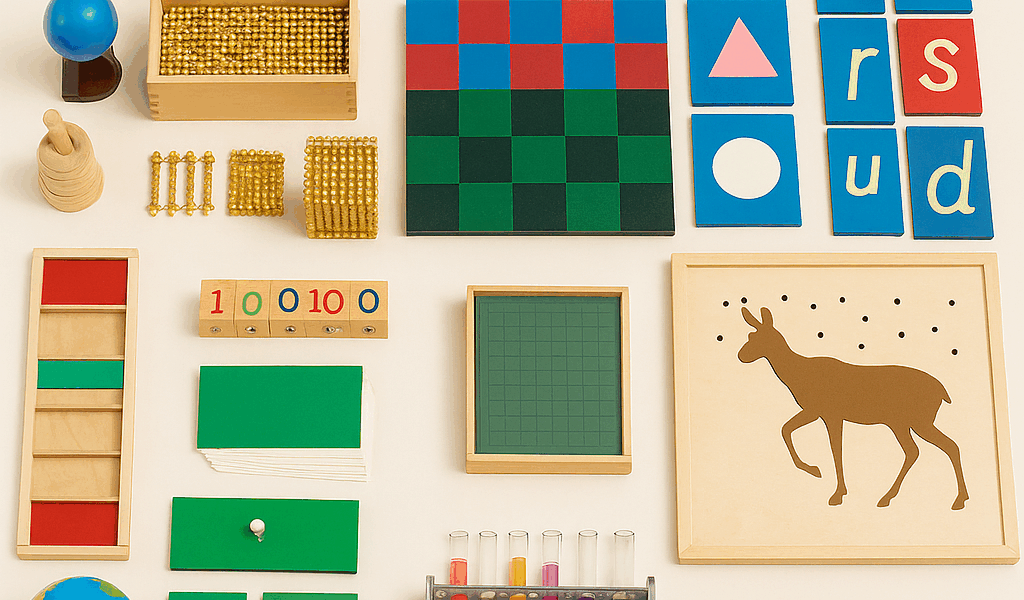
- Sandpaper letters
- Moveable alphabet
- Metal insets
- Phonetic object boxes
- Phonogram cards
- Classified picture cards
- Early readers
Math
- Number rods
- Sandpaper numbers
- Spindle boxes
- Cards and counters
- Golden beads (intro to decimal system)
- Teen boards and ten boards
- Hundred board
- Bead stair (1–9 colored beads)
Cultural (Geography, Science, Arts)
- Puzzle maps of continents and countries
- Land and water forms
- Globe (continent globe, sandpaper globe)
- Botany puzzles (leaf, flower, tree puzzles)
- Zoology puzzles (mammals, birds, fish, amphibians, reptiles)
- Classified cards for animals, plants, geography
- Music bells
Lower Elementary (6–9 years; Grades 1–3)
Math
- Golden bead material (expanded for operations)
- Stamp game
- Bead chains & squares (short/long chains for skip counting, squares, and cubes)
- Bead frame (small bead frame)
- Checkerboard for multiplication
- Division board & racks and tubes
- Fraction insets and skittles
Language
- Grammar symbols & boxes
- Sentence analysis materials
- Word study materials (prefixes, suffixes, compound words)
- Classified reading cards
- Advanced moveable alphabet
- Reading classification charts
Cultural
- Timeline of Life, Timeline of Humans
- Fundamental Needs of Humans chart
- Command cards for science experiments
- Continent and country maps with labels
- Geometry sticks, equivalence materials (fractions & geometry)
- Botany & zoology charts and classification materials
Upper Elementary (9–12 years; Grades 4–6)
Math
- Large bead frame
- Algebraic pegboard
- Negative snake game
- Decanomial beads
- Square root board
- Cubing material
- Advanced fraction materials
Language
- Advanced grammar boxes
- Verb conjugation materials
- Sentence analysis (complex/compound sentences)
- Word study for etymology and roots
- Research materials for writing projects
Cultural
- Advanced timelines (civilizations, inventions)
- Economic geography materials
- Political and physical maps with advanced labeling
- Physics and chemistry experiment sets
- Advanced geometry materials (constructive triangles, geometry cabinet extensions)
Adolescence (12–18 years; Middle–High School)
Montessori for adolescents shifts toward real-world applications. Materials look less like classroom manipulatives and more like project-based, practical tools:
- Farm tools and materials (for Erdkinder programs)
- Business management tools (ledgers, financial tracking, entrepreneurship projects)
- Advanced math manipulatives (algebra tiles, geometric models)
- Lab science equipment (microscopes, chemistry sets, physics apparatus)
- Research resources (primary source documents, advanced maps, historical timelines)
- Writing and publishing tools (journals, computers, presentation equipment)